
Bomb Hoaxes Disrupt European Flights as Police Search Aircraft
Flights were diverted or searched after bomb threats across Europe. Completed checks reported no explosives; investigators have not established who sent the messages.
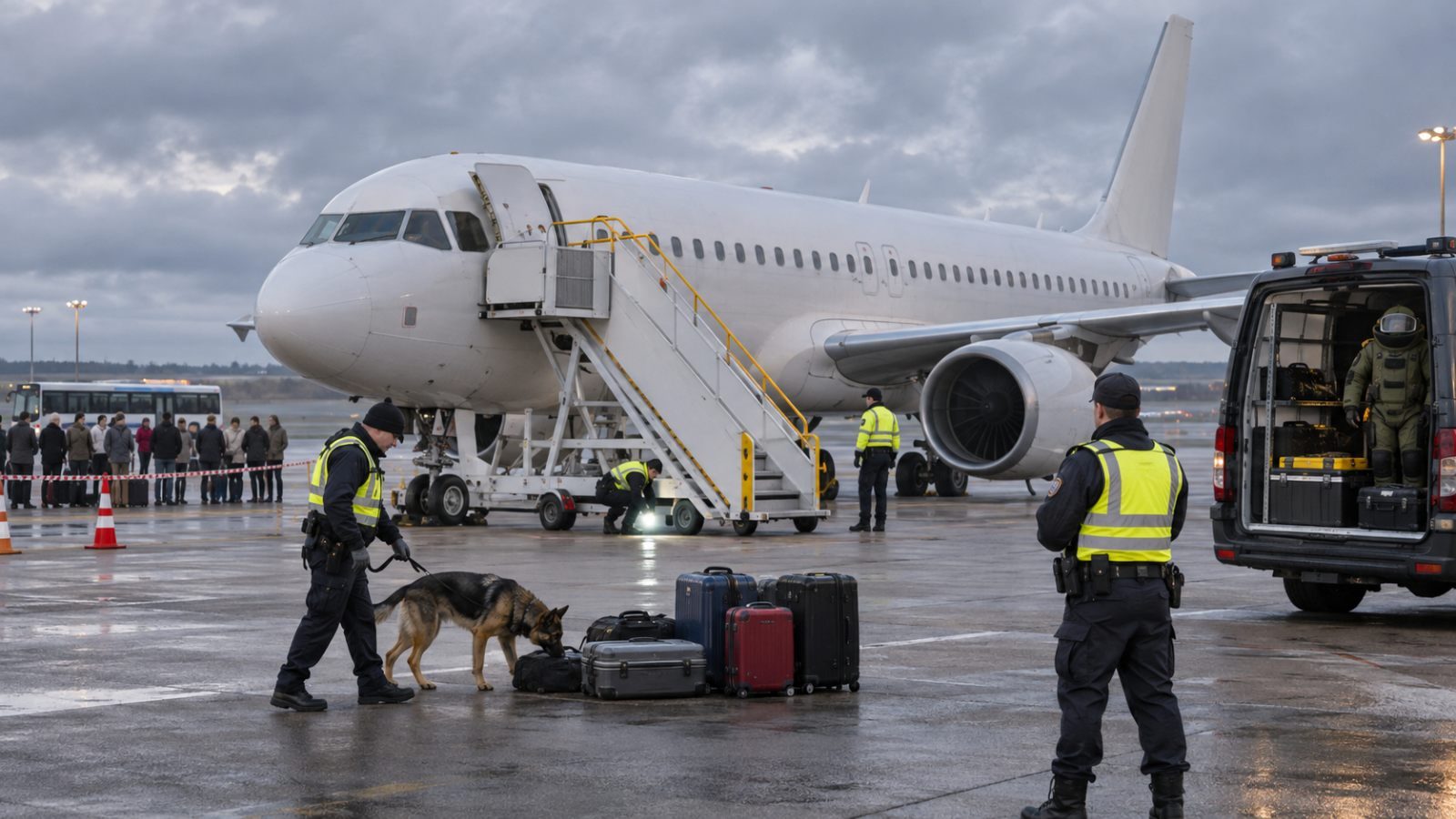
Bomb threats prompted aircraft diversions, police searches and delays on routes across Europe on Thursday, 5 November. Authorities reported finding no explosives in the inspections completed at the time of reporting, but investigations into who sent the messages were continuing.
Among the incidents was an Aer Lingus aircraft travelling from Dublin to Rome that diverted to a French military airbase at Évreux. Authorities also examined flights affected by alerts at Madrid-Barajas and Prague airports, while Aegean Airlines and Finnair reported threats involving services to Italy and Austria.
The alerts were among a succession of incidents reported at European airports this week. Aviation authorities are investigating their origin, but no government has publicly established who was responsible for the messages.
How the disruptions unfolded
At Prague, Czech police prepared to inspect four aircraft after warnings were received. Searches found nothing suspicious, according to reports from authorities. In Spain, the Guardia Civil reported emailed threats affecting flights at Madrid-Barajas. Passengers faced security checks and, in some cases, schedule changes.
The Dublin-to-Rome flight was directed to a military base in northern France as a precaution. A diversion of that kind is a protective response to a possible threat; it is not proof that an explosive device was present.
Several carriers subsequently said checks had not substantiated the warnings. That allowed operations to resume, although knock-on delays can continue after the immediate security response ends.
Confirmed disruption does not establish a common culprit
The alerts affected different airlines, airports and flight routes. Their similar timing may warrant investigation, but it does not establish that one organisation sent them all. Associated Press reported searches in Prague and other emergency procedures, while Reuters documented diversions involving several countries. As each episode develops independently, any claim of a coordinated operation needs evidence from investigators.
No confirmed source of the messages
The series has raised concern about how unverified threats can disrupt airline operations, whether or not the messages prove to have a common author. Even an unsubstantiated message can require an emergency landing, police deployment and a full aircraft search when public safety is involved.
European officials have also expressed concern about sabotage and other forms of disruption in the broader security environment. However, those concerns should not be confused with evidence about these specific threats. Responsibility for Thursday's messages has not been independently established.
Passengers travelling through affected airports are best served by checking their airline's latest flight information rather than assuming that all flights at an airport are suspended. Authorities have given no indication that every service at the named airports was disrupted.
The investigation continues, with airlines and police expected to review how the messages were delivered and whether different incidents are connected. The immediate finding remains that no explosives were reported in the searches described by authorities.
Reporting sources
- Associated Press – live reporting, 5 November
- Reuters – European flight disruptions
- Reuters – incident-by-incident factbox
Sources

Musa Ersoy
Musa Ersoy is an editor and writer at DEFUXA Global News, covering developments in the United Kingdom and around the world. He researches news stories using official statements, credible sources and independently verifiable information. His editorial work focuses on factual ac…
Author profile and articles